/replacement-stair-spindles-matching-originals
Replacement stair spindles matching originals
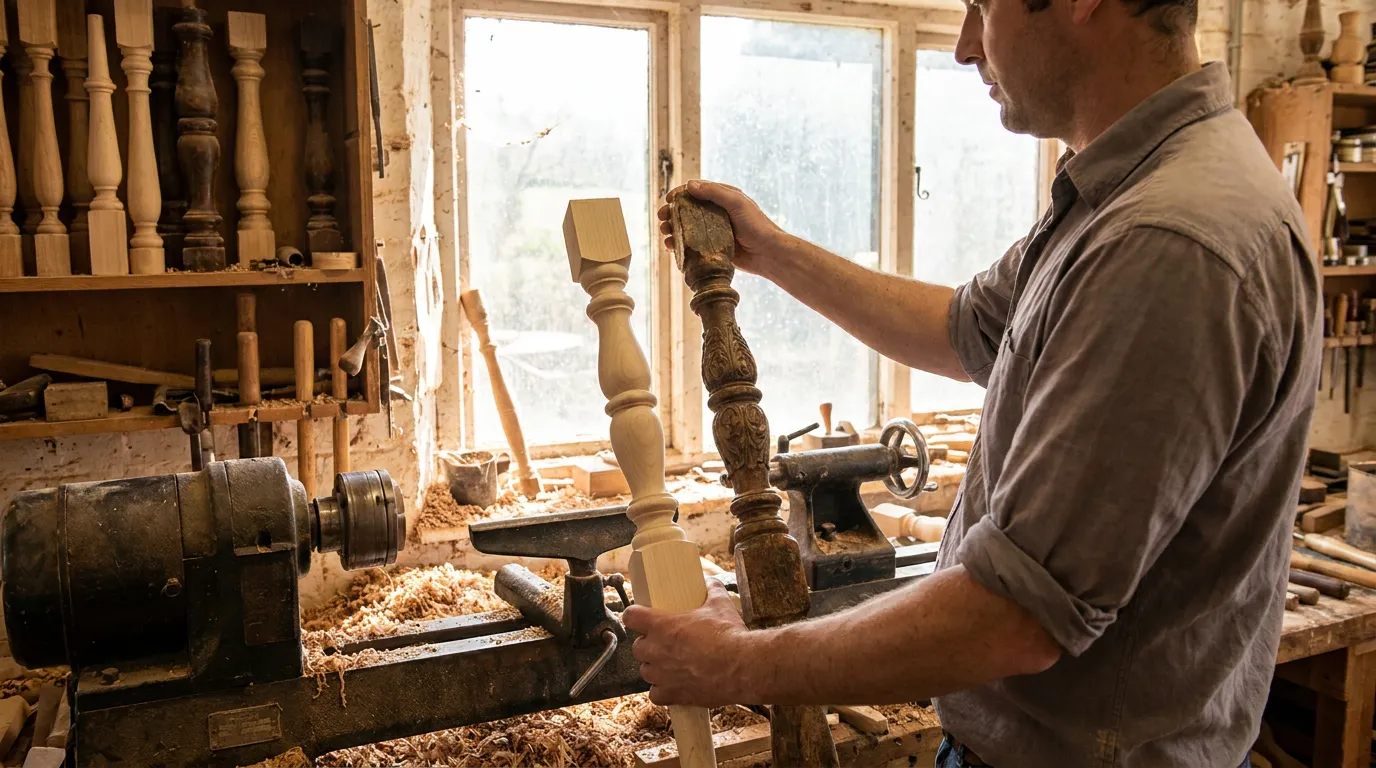
Yes, you can source replacement stair spindles matching originals for most UK period homes, but a true match usually needs a bespoke maker rather than an off-the-shelf spindle kit. Daniel Fitzpatrick, a Honley-based turner with three decades on the lathe, has copied missing or broken Victorian and Edwardian profiles from photographs, sketches and surviving fragments since 1995, working in kiln-dried premium timbers alongside related furniture parts such as table legs and kitchen pilasters including barley twist designs.

If you still have original spindles in place, even one intact example is enough. Daniel mounts it on the lathe, studies the bead-and-bar sequence, and reproduces the profile to within fractions of a millimetre. Clients send a short spindle, a snapped piece, or close-up photos; sometimes all three.
Off-the-shelf ranges rarely line up. B&Q and Screwfix sell modern bar-and-stop designs in standard 32mm and 41mm sizes that don't suit an 1890s barley-twist or a 1905 gun-barrel profile. That gap is why a small family workshop with traditional lathes stays busy three decades in.
Can you replace just the spindles on a staircase?
Yes. In most homes you can replace only the spindles on a staircase while keeping the existing handrail, baserail and newel posts in place, and that is often the most practical route when the surrounding timber is sound but individual balusters have cracked, snapped or gone missing.
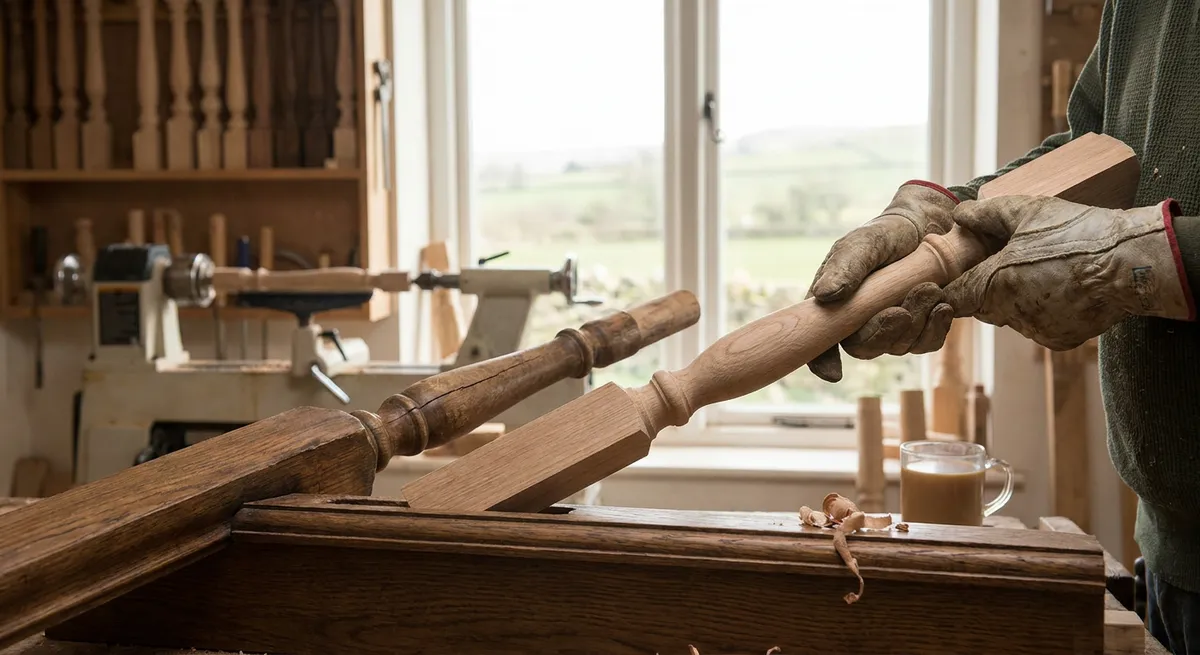
Keeping the handrail and newel posts in place
Reusing the original handrail and newels saves a surprising amount of work. A Victorian or Edwardian handrail that has been on the wall for a century is rarely easy to remove without marking the plaster, and a new hardwood rail costs far more than a set of replacement spindles. As a rule of thumb, if the existing posts and rails are square, solid and free from rot at the joints, leave them where they are.
Three trade-offs worth weighing before you commit:
- Old and new timber take stain differently, so matched spindles may still read slightly darker or lighter until a final coat of finish unifies them.
- Existing holes in the handrail and baserail dictate the spacing. Working to the old positions avoids patching, but it also means you inherit any uneven gaps left by the original fitter.
- If the baserail has a worn groove or the handrail sockets have been over-painted, clean them out with a chisel and a scraper before dry-fitting the new balusters.
When partial replacement causes hidden problems
Partial replacement goes wrong when the structure beneath is tired. Tap each newel post at the base; a hollow sound often points to wet rot where the post meets the stair string. Check the underside of the handrail where it sits in the wall brackets, and look for daylight between the baserail and the treads. Any movement here means the new spindles will work loose within a season.
From the workshop, the jobs that come back are almost always the ones where the rail looked fine from the front but the fixings had failed behind. If you find movement, stop and address the frame before ordering turned parts. A small family workshop in Honley turns each piece by hand and can replicate a profile from a photograph, a sketch or a surviving sample, alongside related furniture parts such as table legs, kitchen pilasters (barley twist) and hand-turned staircase spindles and newel posts, which is how most period-property clients end up with a clean match without rebuilding the whole flight.
How much does it cost to replace staircase spindles?
Replacement stair spindles typically cost between £15 and £45 each in standard timber, while bespoke hand-turned copies matched to your originals usually fall between £40 and £90 per spindle depending on timber, profile complexity, and quantity. A full flight of 30 to 40 spindles, therefore, ranges from roughly £1,200 to £3,600 for a true like-for-like replication.
What drives the price up or down
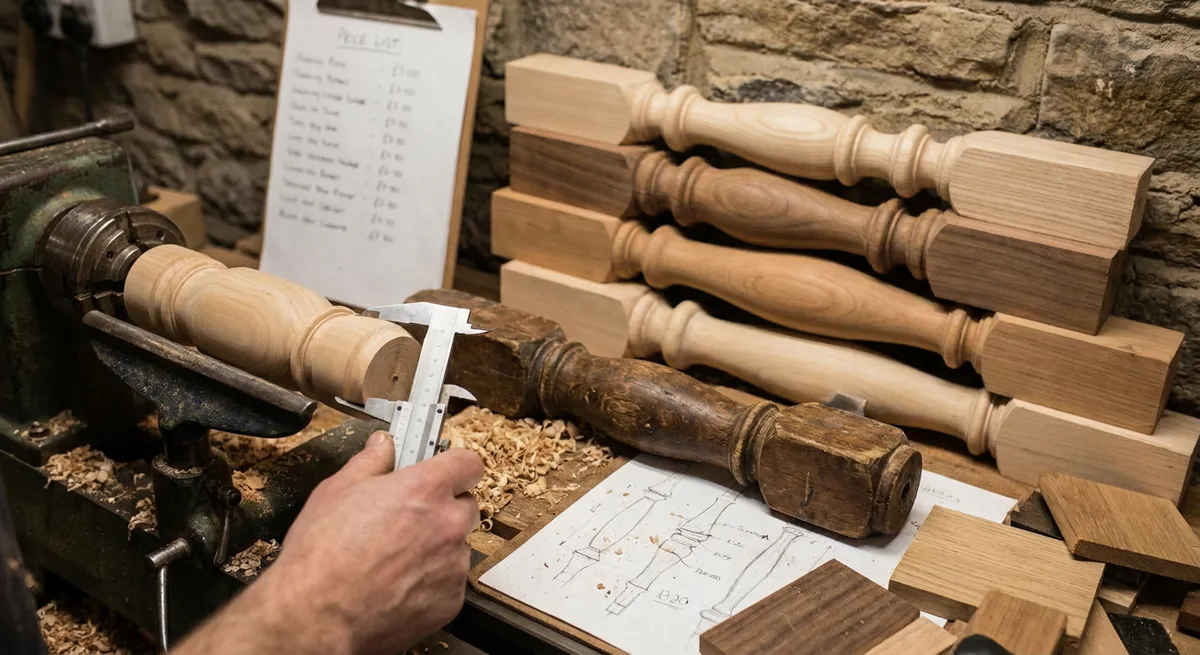
The biggest cost driver is the profile. A simple square or stop-chamfered spindle takes minutes to turn; a barley twist, gun barrel, or fluted Victorian pattern requires careful setup and a steady hand, which is why off-the-shelf kits rarely cover anything beyond the most common shapes. Timber choice matters too. Softwood (pine) is the cheapest option at £15 to £25 per spindle, while kiln-dried oak, ash, or European walnut sit at the upper end because they machine cleanly and age well.
Quantity affects unit price in a measurable way. Most turners, including our Honley workshop, build a small price break into orders of 20 or more because the lathe setup stays the same whether you need ten or thirty spindles. Quantity also lets us keep a consistent grain and tone across the whole run, which matters when the originals have darkened over decades.
Other variables that shift the bottom line:
- Matching existing work. Copying an unusual or worn profile from photographs, sketches or a sample adds design time but is usually cheaper than ripping out a sound handrail and newel system.
- Finishing. Leaving spindles in the white for you to paint or stain keeps costs down; pre-finishing with hardwax oil or shellac adds labour but saves you a weekend.
- Delivery. UK-wide courier on a parcel of 30 to 40 turned spindles is modest, but urgent turnaround or export packing increases it.
Comparing off-the-shelf kits with a made-to-match service
High-street stair-part kits from B&Q, Screwfix, or online catalogues work well for new-build staircases with standard 41mm round or square balusters in softwood or white-primed timber. They are the right answer when nothing original needs preserving. They are the wrong answer when you own a Victorian or Edwardian property and one or two spindles have snapped, rotted, or gone missing.
Pre-1950s spindles were usually turned on a rotary knife lathe by a local joiner, so the chance of finding an off-the-shelf match is slim. A made-to-match service reads your photograph, drawing, or surviving sample, builds a one-off template, and turns each replacement by hand so it sits flush against the original handrail and baserail. The trade-off is lead time (two to four weeks is typical) and unit cost, but you keep the character of the house and avoid a mismatched balustrade that drops the value on resale.
Quick cost checklist
Before requesting a quote, count the spindles you need, measure the run length between newel posts, and photograph any surviving originals from two angles. Send those with your postcode and we can give you a firm price within a working day, usually cheaper than a full staircase refit and almost always cheaper than living with the gap.
Measuring, spacing, and sizing replacement stair spindles
Are all stair spindles the same size?
No. Replacement stair spindles vary widely in length, width, and profile. Common lengths run between 900mm and 1100mm, with 41mm square sections being the most widespread modern standard. Period originals often measure closer to 32mm or 35mm square, with turned profiles that swell at the centre or taper at each end. Off-the-shelf parts from high-street ranges rarely match these dimensions, which is why a like-for-like swap usually needs a bespoke turner.
Calculating how many spindles you need and meeting the 100mm gap rule
Start by measuring the total run each spindle covers between the baserail and handrail, then divide that run by your chosen spacing. UK Building Regulations (Approved Document K) require that a 100mm sphere cannot pass through any opening in the balustrade, which sets a maximum clear gap of 99mm between spindles.
A practical rule our workshop uses for matching originals in period homes:
- Measure each gap on the existing staircase rather than relying on a single average, since old flights often vary by 5–10mm.
- Calculate the gap first, then choose the spindle count. A 32mm spindle with 99mm gaps needs roughly one spindle every 131mm of run.
- Keep the original spacing if the balustrade still passes a 100mm sphere check. Reusing positions saves filling old holes and keeps the look authentic.
- For Victorian and Edwardian flights, count the original spindles per tread before removing any. Photos of the bare baserail help us replicate the pattern exactly.
If your existing gaps exceed 99mm, you will need more spindles, not fewer. We regularly replicate Edwardian barley-twist balusters with finer 28mm shanks to bring an old flight back into compliance without altering the handrail.
For bespoke replication or to discuss your project, get in touch with the workshop.
Matching originals in Victorian and Edwardian homes
Replacing one or two damaged spindles in a Victorian or Edwardian staircase is straightforward in theory but rarely simple in practice. Most spindles made before 1950 were turned by hand or on early rotary knife lathes, often by local joiners working to their own templates. The result is a huge variety of profiles, from slender barley twists to chunky gun barrel shapes, with no two streets quite the same.
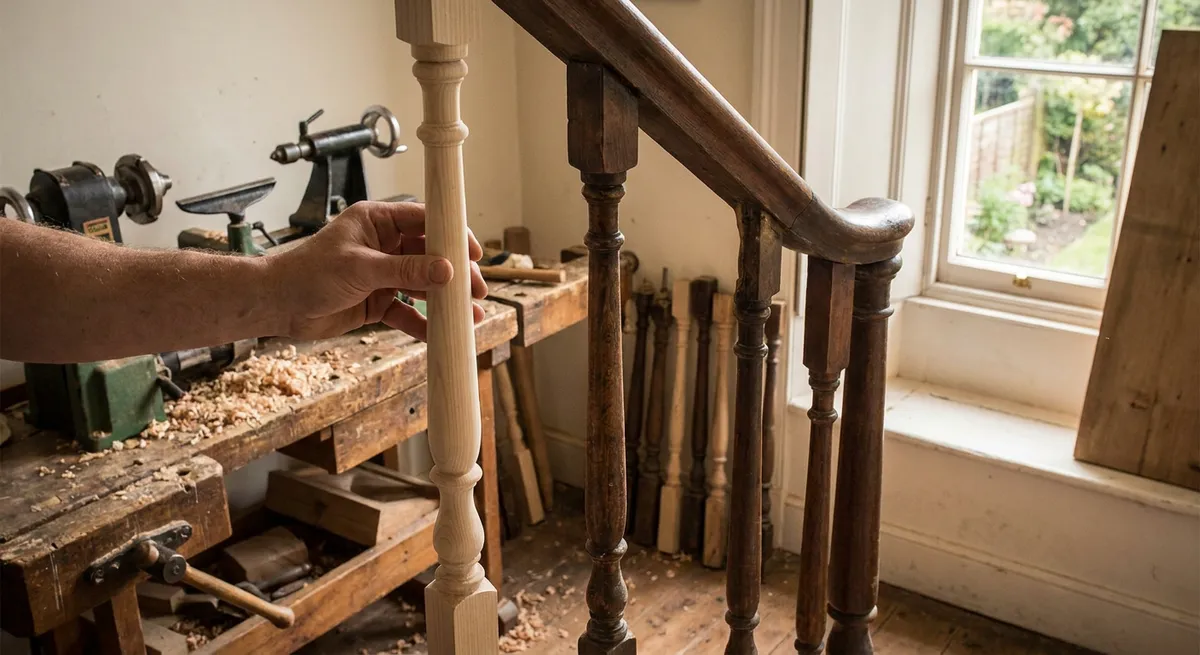
How to match balusters to existing turned designs
Matching an existing baluster starts with a close look at the profile, not just the timber. Count the number of beads, twists, or rings, and measure the thickest and thinnest sections. A photograph taken square-on, with a ruler or coin held beside the spindle for scale, is often more useful than a tape measure. At our Honley workshop, we keep a library of templates built up since 1995, but we still trace or measure every original before we cut, because timber moves and detail can read differently after decades of polish.
For Victorian work, look for slender, ornate profiles with fine beads and sharp transitions. Edwardian spindles tend to be plainer and slightly thicker, with longer clean shafts between details. If you cannot find an off-the-shelf part at a national retailer, a bespoke woodturner can copy from a sound original, a clear photograph, or a hand-drawn sketch using bespoke design matching from sketches or photographs and traditional custom wood turning methods passed down through the trade.
Trimming, fitting, and finishing handmade replacements
Most spindles are 32mm square at the top and bottom, but the length varies with every staircase. Measure the gap between the baserail and the underside of the handrail at three or four points along the run, then trim the new spindle to the shortest of those measurements. Use a fine-tooth saw and sand the cut end before dry-fitting.
Pre-finish every part before installation. For softwood, two coats of varnish or wax work well; for hardwood, oil or wax ages more gracefully and is easier to refresh. Seal the end grain twice, as it soaks up finish faster than the sides. Once the spindle sits flush and the joints are tight, pin it through the baserail and fix into the handrail groove.
A short decision rule from the bench: if more than three spindles in a run are damaged, replace the full set. Patchy matching draws the eye more than a single tidy replacement.
Your next step: getting an accurate match
Send a sample, photograph, or sketch for copying
The most reliable way to match originals is to send a physical sample. Pop one old spindle in the post and Daniel Fitzpatrick can read the profile, count the beads, measure the tapers, and turn a faithful copy from a kiln-dried timber of your choice. A clear photograph taken square-on with a ruler alongside works for a quick quote, and a hand-drawn sketch with dimensions gives enough to start when nothing physical survives.
Three things speed up the process: state the timber you want (oak, pine, or a colour-matched hardwood), give the finished length and the bare-shaft length between fillets, and mention how many you need. Most batches run between four and forty pieces, and a set of eight matching originals can usually be on the bench within a fortnight of a sample arriving at the Honley workshop.
When to use the Spindles Woodturning bespoke service
Choose the bespoke route when the staircase dates from the Victorian or Edwardian era and the existing spindles carry hand-cut detail no shop-bought bar stock can replicate. It is also the right call when only two or three replacements are needed and a whole kit would leave half a dozen offcuts. Replacement work of this kind demands more than a standard turned bar from a builders' merchant.
For straightforward modern replacements, an off-the-shelf staircase spindle kit in softwood or metal may be quicker and cheaper. Bear in mind the trade-offs: a kit rarely matches the timber tone of an old flight, and trimming metal bars needs a proper hacksaw rather than a coping saw.
As a practical rule from the workshop: if the original spindles are over sixty years old, carry a turned profile no longer in production, or show damage beyond a clean break, send a sample. Anything newer and more standardised can often be filled from stock.
Post your sample to Spindles Woodturning, Unit 12, Honley Industrial Estate, Honley, Holmfirth, HD9 6NW, or request a callback with photographs attached.
Sources
- STAIR SPINDLES & NEWEL POSTS COPIED TO MATCH
- How to Update a 1990s Staircase
- How to Replace Balusters to Update Your Stair Railing
- Stair Balusters, Spindles & Shoes | Wrought Iron Balusters | Metal Balusters for Stairs
- USA Made & Amish Craftsman Designed Newel Posts & Baluster Spindles – StepUP Stair Parts
- Wood Balusters & Stairs Spindles in 25 Wood Species
- Wood Balusters - Stair Spindles - Shop Online - Made in USA - Kinzel Wood Products
- Transform Your Staircase: DIY Metal Balusters Revamp