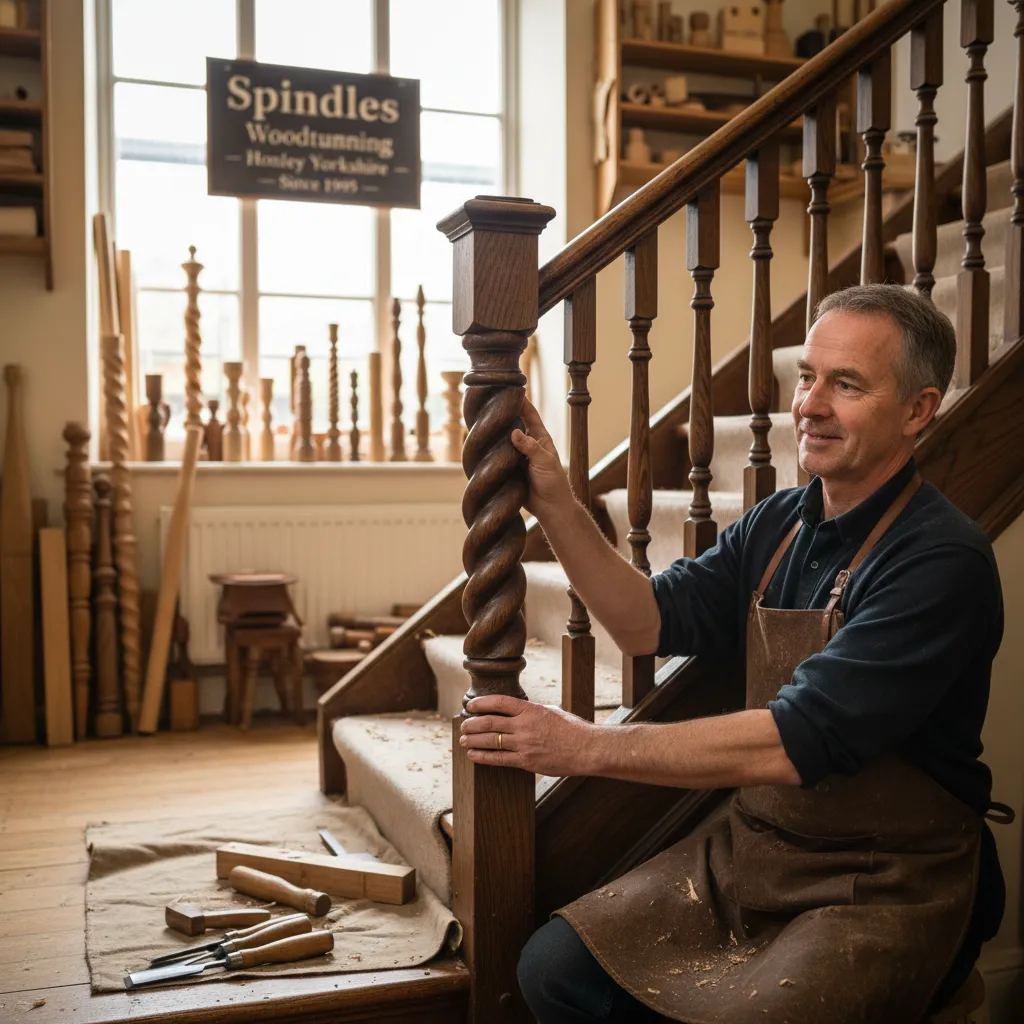
Quick answer: bespoke barley twist newel post made to match existing staircase
Yes. A hand-turner can produce a bespoke barley twist newel post made to match existing staircase joinery by replicating the original profile, dimensions, and timber from your photos, sketches, or a physical reference.
What does the matching process involve?
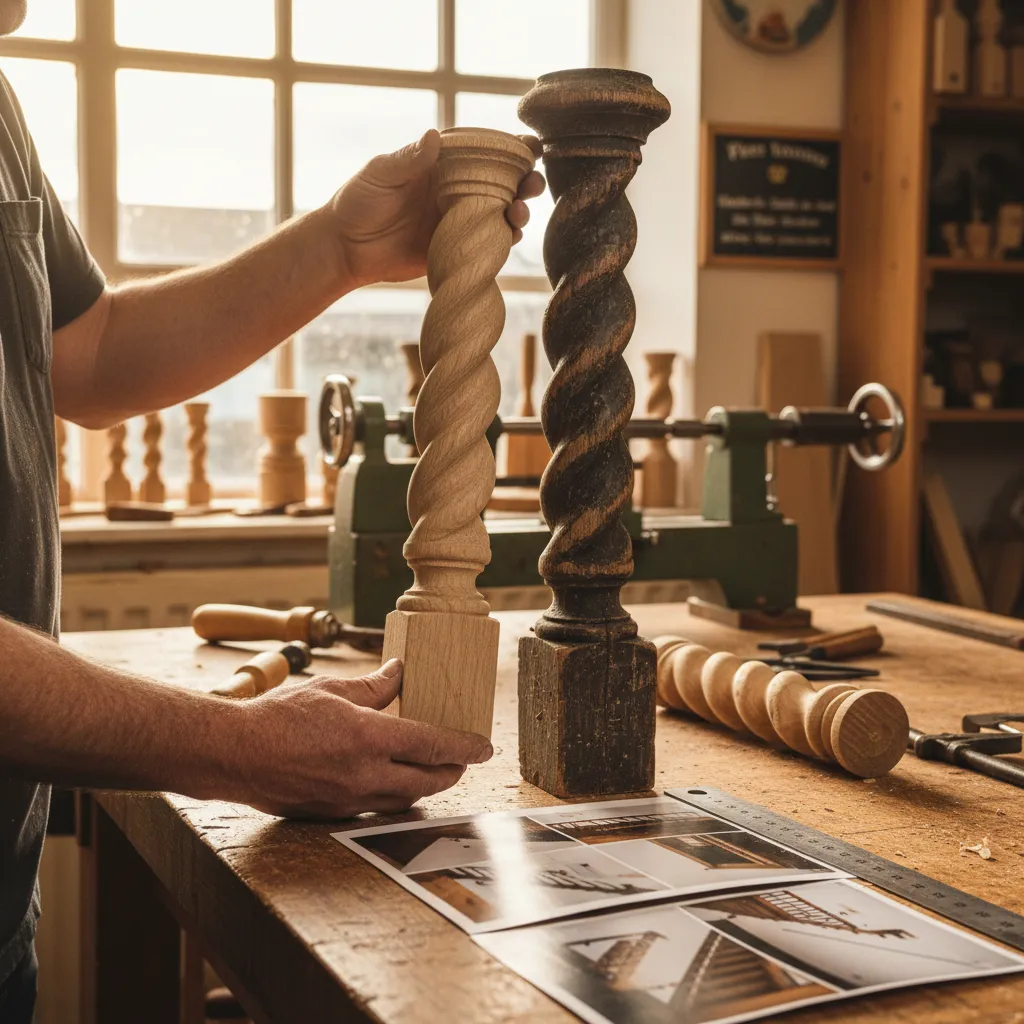
Send clear photographs of the existing post from at least three angles, plus the shaft width and overall height. Daniel Fitzpatrick at Spindles Woodturning, a small family workshop in Honley, Yorkshire, reads those references and turns a sample piece for sign-off before producing the final post. The sample step lets you check spiral pitch, end cap, and timber tone against the original before the full run leaves the lathe.
What details help the workshop replicate the original?
Three pieces of information lift replica accuracy: a close-up of the twist pattern, the exact shaft diameter (commonly 90mm or 120mm), and the timber species. Oak and ash read warm and open-grained; pine and hemlock sit paler and softer, which suits Edwardian and Yorkshire cottage staircases.
How long does a single matching post take?
A standalone barley twist newel post in stock timber usually leaves the Honley workshop within 10 working days of sample approval. Complex replicas with carved caps, distress marks, or unusual spiral counts run longer, because each hand cut adds lathe time.
When is matching not the right call?
If the rest of the staircase has shrunk, faded, or been stripped, a perfect match will look newer than its neighbours. Ask for a deliberately aged or toned finish instead of a crisp off-the-lathe surface.
Next step
Send your photos, shaft width, and timber note to Spindles Woodturning, or call 01484 666 333 to discuss a sample piece before placing the full order.
Adding, Replacing and Upgrading a Newel Post on an Existing Staircase
How to add a newel post to an existing staircase
A newel post can be added to an existing staircase without rebuilding the flight, provided the string or landing has a solid fixing point and the floor below can take a suitable newel bolt or dowel. The post is usually trimmed to height on site, then locked into the riser or trimmer joist with a concealed newel post fastener and grain-matched wood glue.
How to replace a stair newel post
A staircase newel post can be replaced where the original is split, loose, or stylistically out of keeping, as long as the structural newel beneath it is sound. Removing a post usually means drilling out the old newel bolt, easing the damaged post off, and trimming the sub-newel to the same height before dry-fitting the replacement.
For a made-to-match replacement, send in your existing post alongside your sketch so the workshop can copy the original twist count exactly. Matching the new piece to the surrounding staircase spindles keeps the balustrade reading as a single design.
How to upgrade a newel post
A newel post can be upgraded in place by swapping the decorative cap and turning for a more substantial version in matching timber, which gives the staircase a heavier look without touching the structural post. Where the underlying newel is sound, the workshop can turn a like-for-like replacement from kiln-dried oak, ash, pine, or hemlock sized to the existing 90mm or 120mm footprint.
Many clients use the upgrade window to commission a barley twist cap and stronger barley twist shaft to lift the surrounding wooden stair spindles. For wider replacements, a Gun Barrel or Victorian profile cap reads as period-correct next to traditional balusters.
Matching timber, profile and proportion to what is already in place
Send a clear photo of the existing post next to a ruler or tape, a short sketch with dimensions, and a note on the timber. From those, the workshop can match the twist count, cap style, and base moulding to within a millimetre, then turn a sample for sign-off before the final piece leaves the Honley workshop.
The same brief works whether you are ordering a single newel or a full set of stair spindles, table legs, or bed posts for a heritage property. Call 01484 666 333 or email info@spindleswoodturning.com to start a match-up brief.
Choosing the Right Barley Twist Design, Timber and Size
Timber, size and twist style: oak, ash, pine and hemlock compared
Choose oak or ash when the existing staircase already has pale hardwood spindles, or when a new post must survive heavy handling. Oak brings pronounced grain and weight; ash turns cleanly with a lighter, more even appearance.
Pine suits painted staircases because its softer grain takes detail without fighting a coloured finish. Hemlock offers a smooth surface for staining, but matching its pale colour to aged oak usually requires careful sample testing.
The workshop uses kiln-dried premium timber and can match an existing newel post from a sketch, photograph or physical sample. Posts turn at 90mm or 120mm widths, with custom dimensions considered against the original post and adjoining spindles.
A single twist gives one continuous spiral and a quieter profile. A double twist has two opposed spirals, creating a fuller, more decorative Victorian effect; it also needs a larger turning area and can appear busier beside slim spindles.
Newel post types, caps and accessories that finish the look
Full-height, half-turn, quarter-turn, drop-in and barley twist winder posts serve different positions around landings and curved stairs. Confirm the required height, base width, stair pitch and handrail joint before ordering, because a visually accurate profile cannot correct a post that is too short for its fixing.
Ball, acorn, finial, flat or moulded caps change the post's final outline. Matching caps, collars, rope twist spindles, fluted sections and handrail details make a replacement read as part of the original staircase rather than an isolated repair.
Request a sample post and review its timber colour, twist spacing and cap profile before the full run. Send the workshop the post measurements and clear photographs of the existing top, base and adjoining staircase before ordering.
Next Steps, FAQs and How to Commission Your Post
Frequently asked questions about matching and fitting newel posts
How do I add a newel post to an existing staircase? Fit a new newel post by removing a section of handrail and baserail, fixing the post directly into the joist or floor with a dowel or bracket, then trimming it to the height of the existing handrail.
Can you replace a stair newel post? Yes. Saw through the damaged post just above the floor or trimmer, lever out the old stub, and fix a replacement newel post into the same socket using a tight-fitting dowel.
How do I upgrade a newel post? The simplest upgrade is to swap the cap: a chunky ball, pineapple or barley twist cap transforms a plain post without disturbing the structure beneath.
How to replace spindles on stairs: cut each damaged spindle at the top, prise the remaining stub from its socket, then fit new spindles for staircase with matching glue and dowels.
What are the different types of stair newel posts? Full newels anchor landings, half newels sit against walls, quarter-turn newels change direction by 90 degrees, and drop-in (or intermediate) newels break up long runs between landings.
Send a photo or sketch to start your made-to-match commission
The workshop at Honley has matched barley twist newel posts to existing staircases from a single photograph and a millimetre measurement since 1995. Email a clear side-on photo of your existing post alongside the staircase width, the height you need, and your timber preference, or post a sketch with the same details. Replies arrive within one working day with a sample plan and a fixed quote. Phone 01484 666 333 or write to info@spindleswoodturning.com to begin.
Sources
- Hand-built stairwell balustrading featuring artisan-made newel posts - Facebook community post
- Bespoke Turned Newel Post for a Completed Cellar Staircase | H.A. Stiles guide
- 120mm Barley Twist Newel Posts | Spindles Wood Turning collection
- Westfire BT-8660 50-inch Barley Rope Twist Grande Lascala Newel Post listing
- Stair-parts.com product page for the BT8645 Barley Twist Newel Post
- Made-to-order Hemlock Barley Twist Double Block Newel from Woodturners Jackson
- Arnold Wood Turning blog: Six Inspiring Newel Post Concepts for the Home
- Mouldings One stair parts catalogue: made-to-order newel posts and balusters