Quick answer: hand turned victorian newel post uk
What you actually need to know
A hand turned Victorian newel post in the UK is a lathe-shaped timber post, usually 90mm or 120mm square, turned in profiles like barley twist, rope twist, fluted, or acanthus leaf, and made to match a period staircase.
For most readers the fastest path is to send a sketch or photograph of the existing post to a specialist workshop, who will quote from timber, size, and profile.
Spindles Woodturning in Honley, Yorkshire, turns each post by hand on traditional lathes from kiln-dried pine, oak, sapele, or walnut, and has done so since 1995. Stocked 90mm and 120mm turned posts usually leave the workshop in a few days; fully bespoke replication from a photograph takes several weeks.
Common Victorian newel post profiles
Five profiles cover most Victorian staircases you will come across. Knowing which one you have makes quoting accurate and keeps the match convincing.
- Barley twist: continuous open spiral, usually paired with barley-twist spindles.
- Rope twist: a closely wound helix with sharper grooves running along its length.
- Fluted and reeded: slender, elongated grooves or convex ribs running lengthwise down a narrowing column.
- Acanthus leaf: carved leaf collar at top and bottom, the most ornate and the costliest to turn.
- Tapered square: plain chamfered posts, common on restrained landings and tighter budgets.
What affects price and lead time
Four things move the quote: timber species (oak and sapele cost more than pine), post height and base size, profile complexity, and whether a matching set of spindles is also needed. A single replacement post in pine sits at the lower end; a full flight in oak with carved acanthus detail sits at the top end. Trade customers ordering multiple matching posts usually qualify for a bulk discount.
Send a photo, the post height in millimetres, and the base width to info@spindleswoodturning.com or call 01484 666 333 for a same-day quote.
Timber, size, and lathe capabilities that shape your options
Which timber suits a hand-turned Victorian newel post
Oak is the default for buyers specifying a hand turned Victorian newel post, because its open grain holds crisp detail on barley twist, rope twist, and acanthus leaf without chipping. Yellow pine and pitch pine turn cleanly for tapered square or fluted shafts, and take a darker stain that mimics aged Victorian work. Tulipwood works for slim barley twist posts where a pale finish is wanted.
Beech, maple, sapele, and cherry are stable alternatives with shorter lead times. Walnut suits feature posts where a darker, figured timber carries the detail. Trade-off: oak costs more and turns harder on the gouge, while pine is cheaper but shows dents in high-traffic stairwells.
Newel post sizes, types, and spindle matching
The Honley lathe turns square sections up to 120mm and lengths to around 900mm as standard, with longer posts spliced or built in sections for tall landing newels. Common types include full newels at the foot of the flight, half newels against walls, quarter-turn and half-turn posts on winders, drop-in short posts, and pin-top finials for curtail steps.
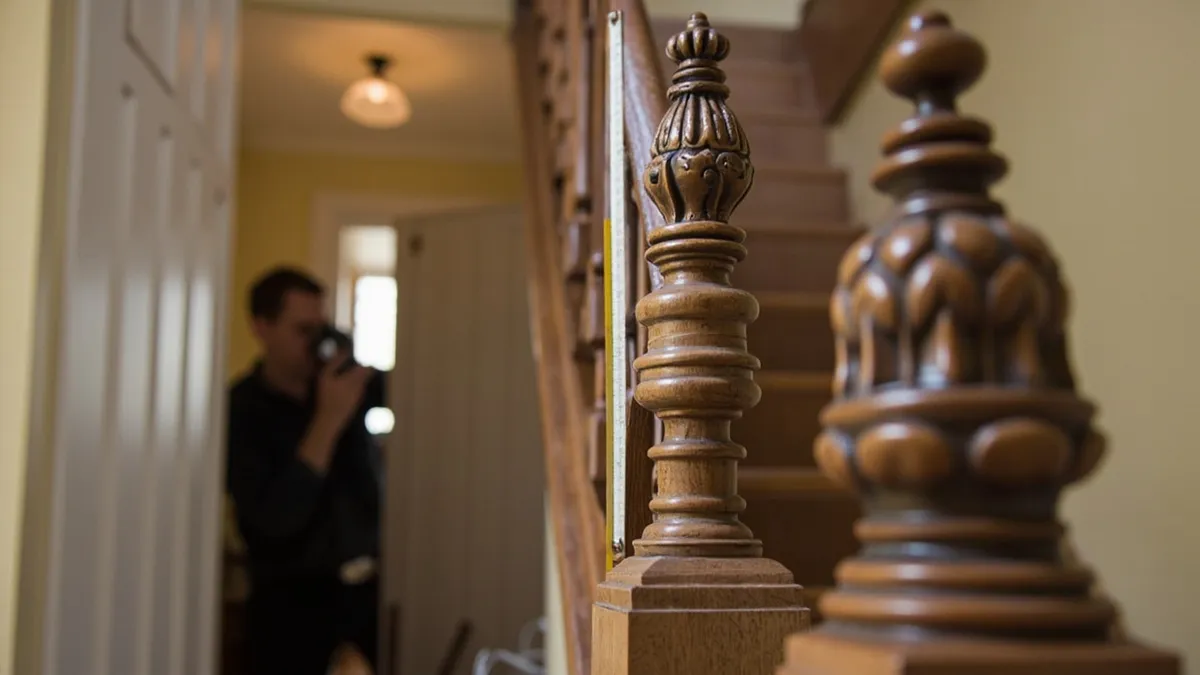
Each newel pairs with a matching spindle set. A single flight often needs four to five spindle lengths, each cut to its own drop. Send a photo of the existing staircase with a tape measure held alongside; that gives Daniel a true scale to work from, which matters more than a written description when matching barley twist pitch or acanthus leaf depth.
Send your sketch, get a quote, plan the right next step
How to commission a matched newel post for a period property
Start by photographing the existing newel post from three angles: straight on, a quarter turn, and a close-up of the finial or top detail. Measure the square width at the base, the overall height, and the diameter of any carved sections. A ruler held in the frame gives Daniel a true scale to work from.
Send those images with your name, postcode, and timber preference. Oak, pine, sapele, and walnut are all common choices, and the workshop can advise which suits your existing stair. A short note on whether the replacement is a full post, half post, or drop-in top half helps Daniel quote accurately. Expect a response within a working day or two, sometimes the same morning.
Trade customers and developers commissioning several posts at once should mention quantities upfront, as bulk orders qualify for discounted rates and can be batched for faster turnaround across the UK.
Speak directly to the workshop to start your project
The fastest route is a phone call on 01484 666 333, where Daniel or a colleague can talk through your job and flag any issues with dimensions or timber before you commit. Email works equally well for those who prefer to attach photos: info@spindleswoodturning.com. Either route reaches the same small family workshop in Honley, not a call centre.
Before you get in touch, confirm three details: the post type (full, quarter turn, half, or drop-in), the timber you want, and whether the new piece needs to match existing spindles or a handrail profile. With those three answers, the workshop can turn your sketch into a finished post without delays. Browse the 120mm Victorian newel post range for standard sizes, or visit the contact page to start a bespoke enquiry.
Sources
- 120mm Victorian Newel Posts Range – Spindles Wood Turning
- Antique Newel Post
- Antique Newel Posts – Etsy UK
- Set of Eight Victorian Newel Posts, Reclaimed
- Regency / Early Victorian Newel Post Example
- Reclaimed Victorian Turned Newel Post with Ball Finial
- Guide to Hand Turned Balusters on Victorian Stairs, Historic Joinery Yorkshire
- Victorian Old World Newel Post NP030