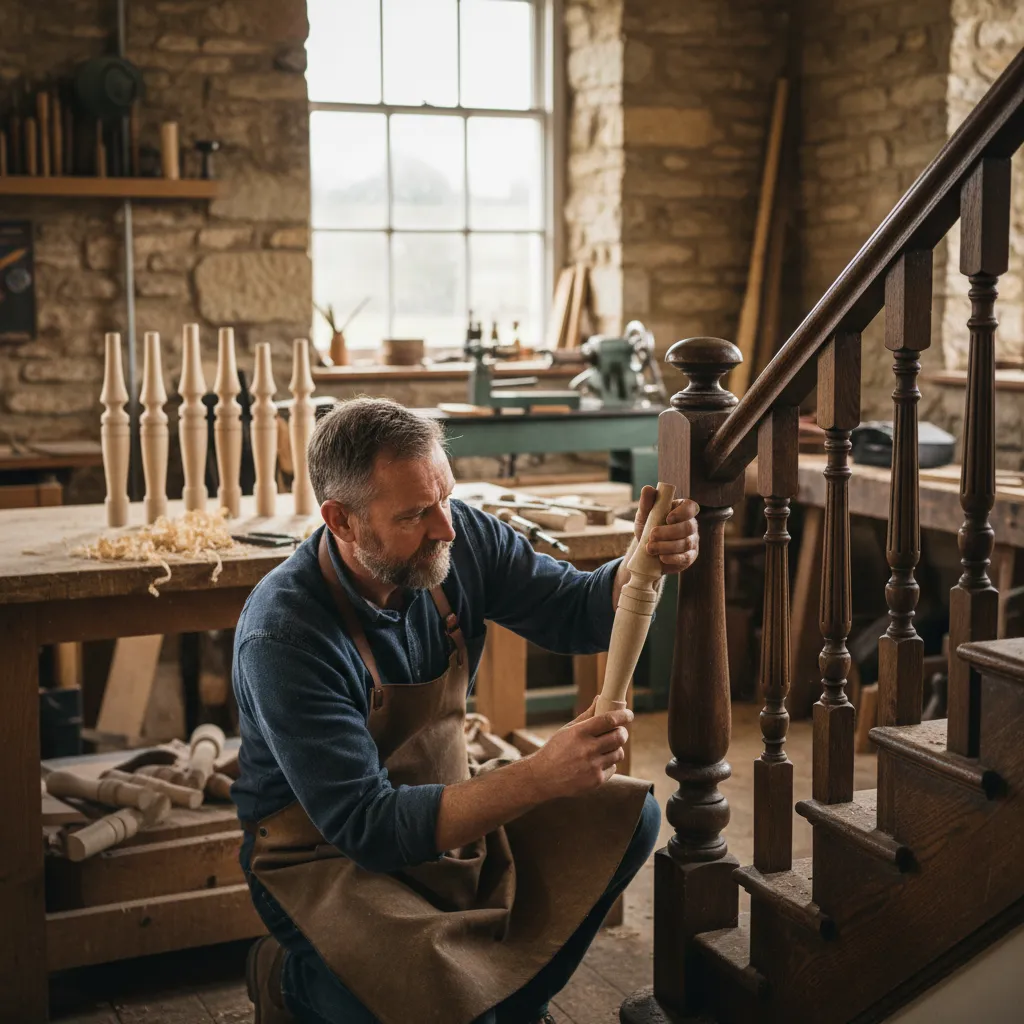
Match Replacement Spindles to Existing Staircase
Quick answer: match replacement spindles to existing staircase
To match replacement spindles to an existing staircase, measure the length, dowel diameter, and centre-to-centre spacing of an original piece, identify the timber species, and send the spindle or its measurements to a hand-turner working in matching hardwoods.
The new balusters should match the original profile, species, and finish so they sit cleanly beside the surviving work.
The same approach works whether you are replacing a single broken spindle or refitting a full flight after restoration work.
Can You Just Change the Spindles on a Staircase?
Is it possible to swap out only the balusters on a staircase?
Yes, individual wooden spindles can usually be swapped without removing the handrail or newel posts, provided the dowel diameter matches and the sockets in the base rail and underside of the handrail remain sound.
Each replacement must match three things to sit cleanly beside the original work: the turned profile, the timber species, and the finish. A Victorian staircase with barley-twist balusters will not accept a plain square spindle without breaking the line of the banister.
On older staircases the spindles are housed into grooves and pinned with a cover moulding. Prize that strip off first with a chisel, then ease each spindle sideways out of its lower housing and pull it downwards to free the top end. If a baluster is stuck or split, cut it flush at both ends with a fine-tooth saw and withdraw the shaft, leaving the housings intact for the new piece.
Modern staircases using metal shoes and screws need a different approach: undo the fixing, withdraw the old spindle, and refit the new one with matching shoes. Older pegs often crumble during removal; grain-matched oak plugs and fresh stair shoes restore the fix.
Always keep the 100mm gap rule in mind. A sphere of that diameter must not pass between any two spindles, a check Building Control applies on every domestic staircase in the UK.
How to Modernise Stair Spindles Without Losing the Character of Your Home
How to modernise stair spindles?
To modernise stair spindles, swap the timber balusters for wrought iron balusters, plain square oak dowels, or frameless glass panels while reusing the existing handrail and newel posts where possible.
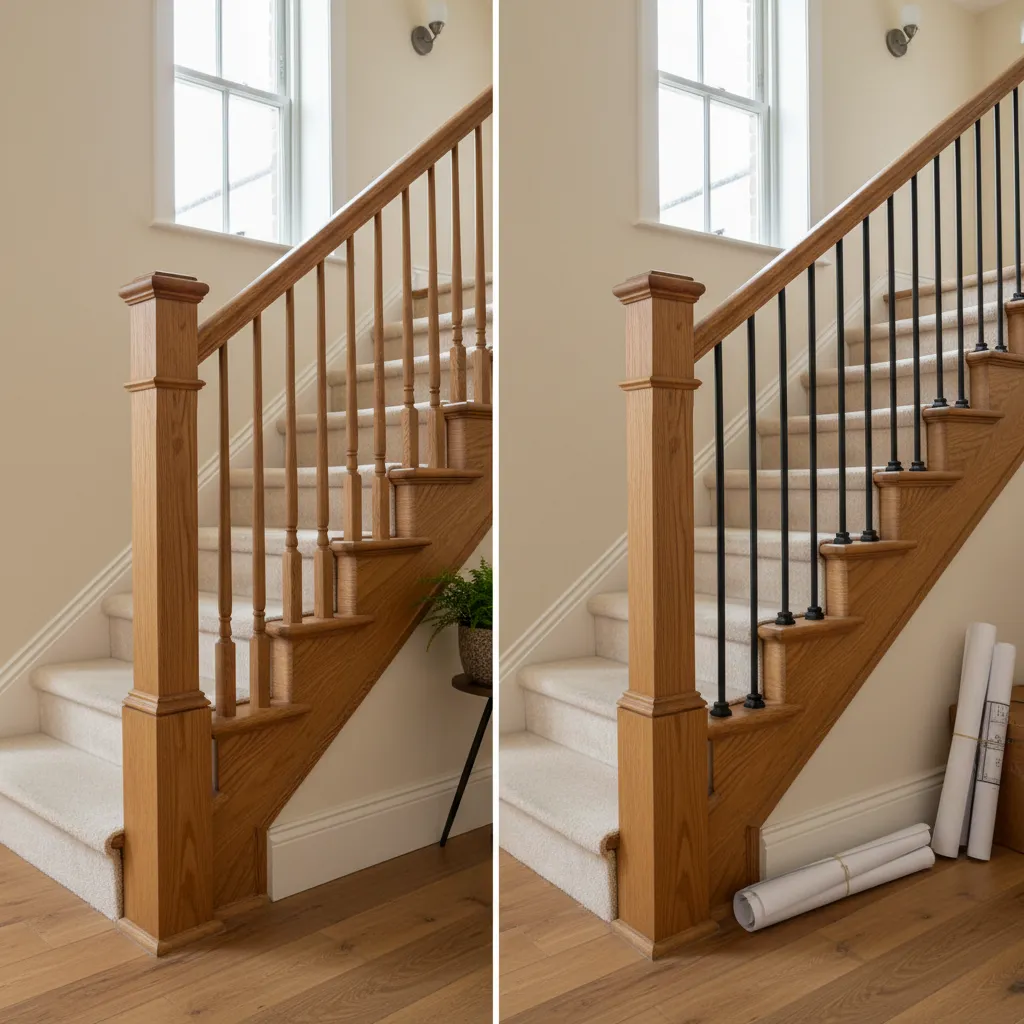
Glass panels brighten a dark hallway and open up the view, and iron balusters give a sharper line against a traditional timber banister. The trade-off is that iron and glass systems suit 1970s and later staircases because the fixing method changes from housed joints to metal shoes and screws, so old mortices are bypassed rather than filled. A typical refit on a 13-riser flight runs to around £450 in iron parts alone, plus a day or two of fitting time.
If you want a heritage look rather than a contemporary one, leave the timber turned profile in place and refinish it instead of changing the material.
What can I replace spindles with?
Wooden balusters, wrought iron balusters, stainless steel rods, or toughened glass panels are the four practical options for most UK homes.
Wood suits period properties best, iron and steel give a sharper modern look, and glass opens up a dark hallway. Whatever you choose, the new balusters must still leave no gap wider than 100mm to satisfy UK Building Regulations.
Can I Get Spindles Made to Order?
Can I get spindles made to order?
Yes, any spindle can be hand-turned to order from a single photograph, a sketch, or a posted sample, with dowel diameter, taper, and timber matched to the existing banister.
A bespoke spindle maker like Spindles Woodturning in Honley, Yorkshire, has been copying Victorian and Edwardian profiles on traditional lathes since 1995, working in kiln-dried oak, ash, beech, or sapele to match the original timber. Daniel Fitzpatrick turns each piece by hand, matching taper, bead sequence, and dowel length to within fractions of a millimetre.
A typical lead time is two to three weeks for a full flight, and UK-wide delivery runs from around £15.
Posting one intact spindle wrapped in bubble wrap inside a stiff card tube lets the turner trace the pattern directly on the lathe, which gives the closest match for non-standard or discontinued designs.
Measure, Identify and Photograph Before Ordering
Measure the spindle, dowels and spacing accurately
Pull one intact spindle from the staircase and measure it end-to-end with a steel tape, including both dowel ends. Most period stair spindles sit between 750mm and 900mm overall, with dowels of roughly 16mm to 22mm. Measure the gap between two surviving spindles too; UK Building Regulations require that the open space never exceeds 100mm, which usually means centres of about 115mm to 120mm on a standard run.
Record three numbers: overall length, dowel diameter, and centre-to-centre spacing. A short note on whether the dowels are housed into a grooved rail or fixed with modern stair shoes helps the maker replicate the fixing method. Send these measurements with any enquiry so the turner can quote accurately and avoid a second round of correspondence.
Identify the timber and match the turned profile
Look at the end grain and any freshly sanded face: Victorian and Edwardian staircases were commonly turned in American white oak, European beech, or pitch pine, while 1930s houses often used stained softwood. Colour alone misleads, so a close-up photograph in daylight, plus a small off-cut if the workshop permits, lets the turner confirm the species.
Trace the profile with a pencil on card or take a side-on photograph beside a ruler. Barley twists, gun barrels, and repeating bead patterns each need their own tooling, and a profile that looks similar at a glance can run to a different number of beads or a tighter taper. Where a sample spindle can be posted wrapped in bubble wrap inside a stiff tube, the turner can copy the taper and beading directly on the lathe, which removes any doubt about matching the existing staircase.
Off-the-Shelf or Made to Order?
When standard hardwood staircase spindles are suitable
Off-the-shelf spindles work when the original design is a common profile still produced today, such as plain square, stopped chamfer, or basic Edwardian barley twist. Modern stair parts from UK timber merchants cover these shapes in oak, pine, and hemlock, with standard dowel sizes of around 20mm to 32mm.
Measure the gap between your handrail and base rail, check the existing dowel diameters with calipers, and confirm the 100mm gap rule is met before ordering. A quick test fit of one spindle from a supplier's range reveals whether the taper, bead pattern, and timber colour sit well alongside your banister without custom turning.
When a bespoke copy is the right call
Go bespoke when the original profile is no longer in production, when the surrounding newel posts, shoe rail, and handrail are all original and need to read as one piece, or when only one or two spindles are damaged and a half-set from a merchant would clash with the rest. Posting a sample or detailed photograph to a single-workshop turner removes the guesswork.
Send Your Measurements or a Sample for a Considered Match
What to send to the spindle maker
Send one intact spindle if you can spare it. A turner uses the original on the lathe to trace its profile, taper, and dowels directly, which catches details a photograph misses. Post it in bubble wrap inside a stiff cardboard tube or a small flat box, and label which end was at the top.
If a spare is not coming out of the staircase, send clear photographs instead. Lay the spindle on a flat surface with a tape measure or ruler running alongside its full length, and shoot from two sides in good daylight. Add a close-up of the dowel end so the turner can read the tenon diameter, plus a wide shot showing the baluster in position between the base rail and handrail.
Note the timber species if you can identify it, and the exact overall length including both dowels. Typical bespoke lead time from a single UK workshop runs at around two to three weeks.
Discuss your newel posts and finishing requirements
Tell the turner whether the new spindles must blend into a Victorian or Edwardian staircase, or stand apart as a deliberate update. Newel post caps and bases often share the same turned pattern as the balusters, so mention if those need copying or refreshing too.
Confirm the finish before work begins. Raw timber, hardwax oil, clear lacquer, or a paint-ready prime coat each change the look and the price. Ask whether stair shoes or fillet strips will be reused, since a colour mismatch at the base rail will betray even a perfect profile copy.
Ring 01484 666 333 or email info@spindleswoodturning.com to start the conversation, or send measurements and photos via the contact page.
Sources
- How to Match Replacement Stair Spindles to Existing Woodwork | Spindles Woodturning
- Replacing Stair Spindles to Match Victorian Banister | Spindles Woodturning
- Can I replace just a few damaged spindles instead of every ...
- The Perfect Match for Your Stair Parts
- Help Guide: Replacing Stair Spindles, Newel Posts and Rails - Blueprint Joinery
- Replacing Stair Spindles: How To Change Stair Spindles
- How to Replace Stair Spindles - DIY Stair Makeover - Bless'er House
- Where to find a custom made staircase baluster to match ...