Quick answer: replace staircase spindles to match existing
You can replace staircase spindles to match existing timber, profile, and spacing on most UK staircases without removing the handrail, baserail, or newel posts.
Five details have to line up: the turned profile, the timber species, the dowel dimensions, the centre-to-centre gap, and the finished colour.
Is it possible to swap out only the spindles on a staircase?
You can change only the spindles if the handrail, baserail, and newel posts are still sound. Most staircases built after 1950 use individual balusters fixed top and bottom, so each one comes out and goes back in on its own.
On older Victorian and Edwardian flights the spindles sit in a continuous groove under a cover moulding. The moulding pries off with a chisel, the old spindles slide sideways, and the new ones drop into the same track. That groove sets the angle automatically.
What to match when ordering replacements
Send a sample spindle if you have one, plus four measurements: overall length, the width across the thickest part, the dowel diameter at each end, and the centre-to-centre gap between spindles. Finish and colour are matched separately on the bench.

Skipping any one of these is the most common reason a replacement job looks wrong on the day it goes in. A 5 mm difference in dowel size leaves a visible gap in the groove; a 10 mm length error stops the newel post cap from closing.
Spindle sizes: 32 mm vs 41 mm
Most UK stair kits use either 32 mm or 41 mm spindles. Older Edwardian and Victorian flights often run 41 mm, sometimes 50 mm for the front entry. Modern stairplan kits and Richard Burbidge ranges default to 32 mm. Measure the dowel at the spindle base before you order; an 8 mm mismatch means new housings in the baserail and handrail.
Profiles and styles worth knowing
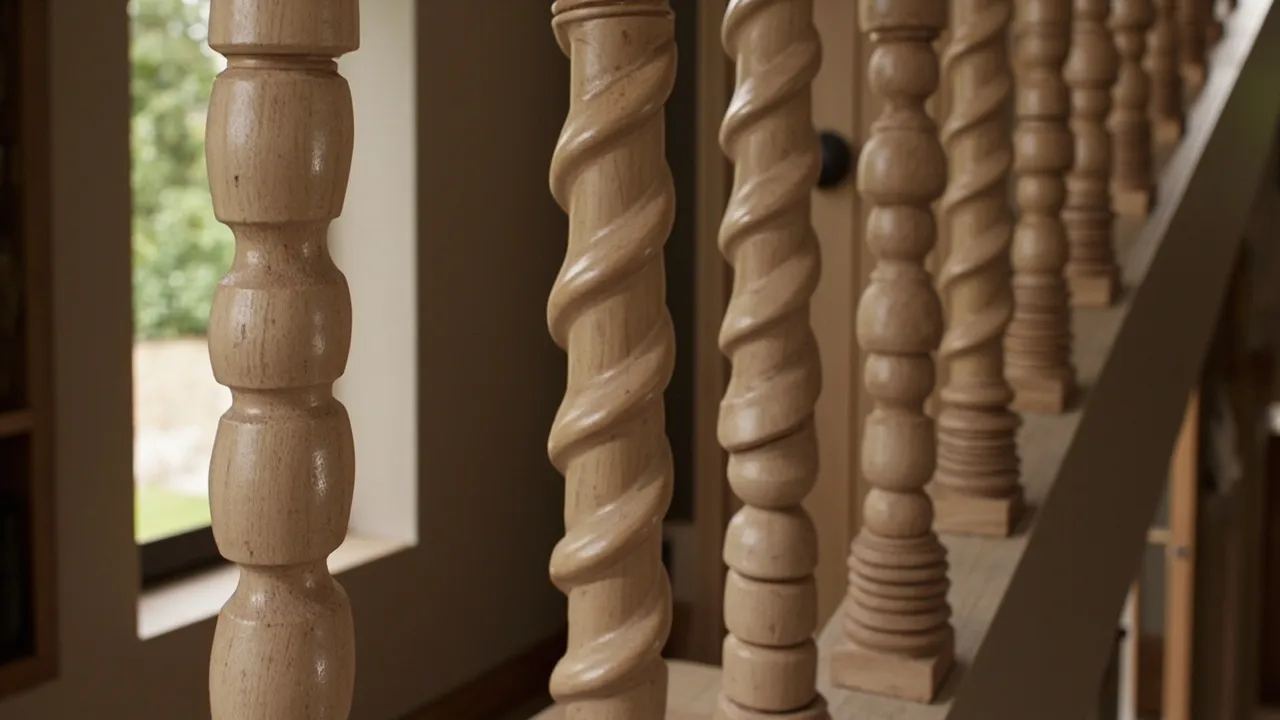
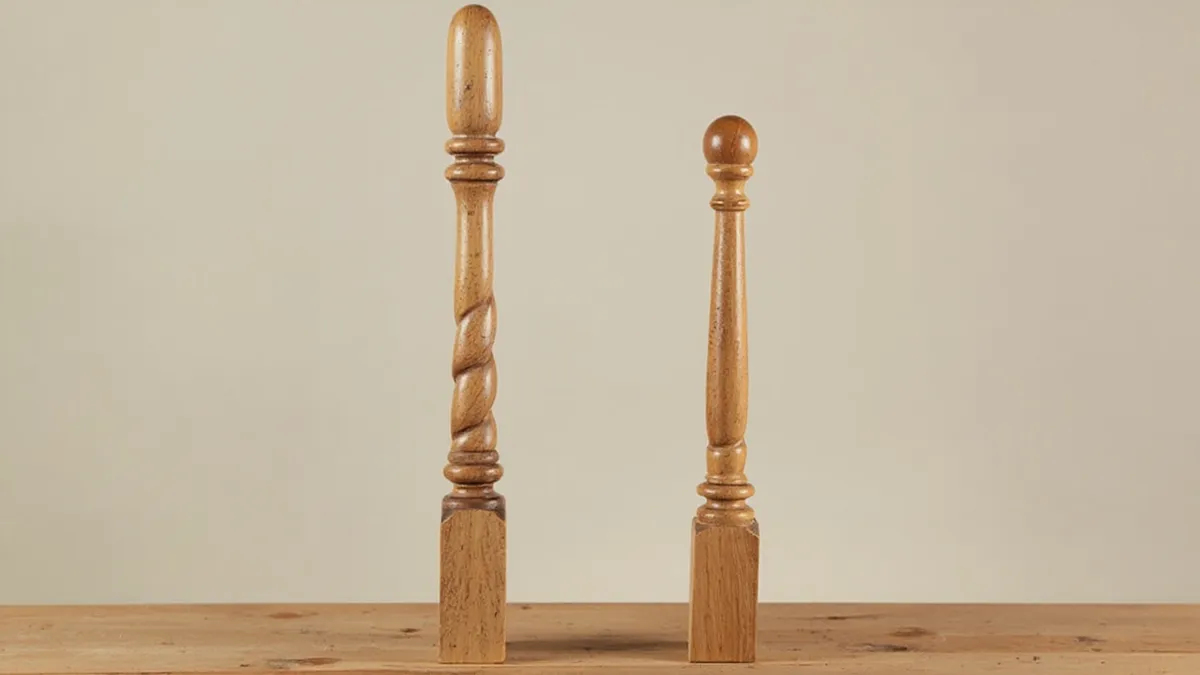
Common UK profiles include plain chamfered, fluted, barley twist, Edwardian, Georgian, Provincial, gun barrel, and basket. Edwardian and Georgian are slim, with restrained tapers and rings. Provincial is a heavier colonial pattern. Barley twist, gun barrel, and basket add visual weight and suit Victorian and farmhouse restorations.
Matching timber species
The timbers that turn cleanly and age well are kiln-dried European oak, ash, beech, maple, and Sapele. American white oak turns sharper detail; European oak has a warmer, slightly more open grain. Pine and hemlock are softer and cheaper, and the rings blur with a few decades of wear. Send a shaving or a 25 mm cut-off so the workshop can match species, not just colour.
When a full replacement makes more sense
Swap the whole set if the originals are warped, cracked at the dowel, or if the gaps no longer meet the 100 mm sphere rule from Approved Document K. Adding a spindle to every other gap is cheaper than refitting the whole balustrade.
For a single damaged spindle, a matched replacement from Spindles Woodturning in Honley is usually the simplest route, since each piece is turned by hand to your measurements. See the contact page or call 01484 666 333 to send a sample or photo for a quote.
Giving stair spindles a more contemporary look
To bring stair spindles up to date, retain the original handrail and newel posts, refinish those timbers, and exchange just the balusters. Trading barley twist or fluted shapes for slender 32 mm plain oak or chamfered dowels opens up the appearance, while the weightier woodwork above stays put. Alternating one turned spindle with one plain spindle eases a hallway's feel without a full strip-out. Share a picture of your existing newel post so the new spindle's thickness at top and bottom sits comfortably with what is already in place.
Must the handrail come off when swapping stair spindles?
You can usually replace stair spindles without removing the handrail. Each baluster fits independently into the baserail below and the handrail groove above. On older stairs a timber cover moulding under the handrail hides the spindle ends and lifts off with a chisel. On newer stairs with metal shoes and screws, undo those fixings and the spindles slide clear.
How much does it cost to replace staircase spindles?
Hand-turned hardwood spindles in the UK typically cost £8 to £25 each, with a full flight of 30 to 40 spindles running £240 to £1,000 in materials alone. Add fitting at roughly £150 to £400 if a joiner handles it. Bespoke replication from a sample costs more than standard profiles, but saves a full balustrade replacement, which often lands at £1,500 to £4,000 for a UK flight.
For a price on matching your existing work, send a photograph, a sample spindle, or measurements to Spindles Woodturning and Daniel will quote from the bench.
Joinery, baserails, and newel posts
Most workshops fix replacement spindles with a 2 mm to 3 mm clearance in the baserail housing, then pin with a 6 mm hardwood dowel through the side of the rail. Some use a Domino or pocket-screw fix into the newel shoulder. Avoid relying on glue alone; the baserail and handrail carry the load, and old softwood rails can split with a heavy glue bead. If the newel base is rotten, a newel post extension or a full replacement sits ahead of the spindle order.
Your next step
The fastest path to a matching spindle is sending a single original, a clear photograph with a ruler for scale, or precise measurements including length, dowel diameter, and profile notes. Most bespoke spindle orders in the Honley workshop ship within 2 to 3 weeks across the UK.
Call 01484 666 333 or email info@spindleswoodturning.com with your sample details to receive a written quote and lead time.
Sources
- Match Replacement Spindles to Existing Staircase: A Guide | Spindles Woodturning
- How to Change the Spindles on a Staircase (Without Rebuilding) | Arnold Wood Turning
- Can I replace just a few damaged spindles instead of every one on my staircase? | Arnold Wood Turning
- Replacement Stair Spindles Matching Originals: A UK Guide | Spindles Woodturning
- Before And After: How to Replace Wood Staircase Spindles
- Replacing Stair Spindles: A DIY Guide
- How to Replace Stair Spindles - DIY Stair Makeover - Bless'er House
- FloorWerks | Staircase Renewal